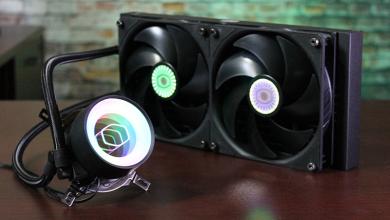
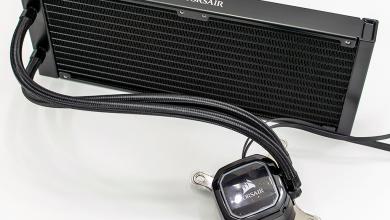
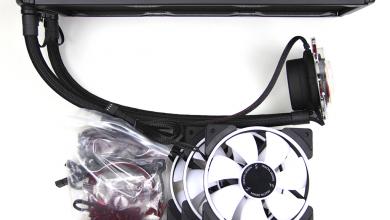
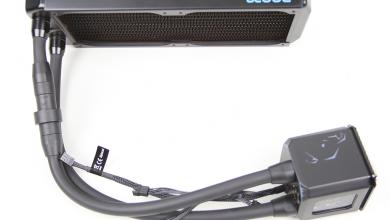
Test System and Benchmark Results of the Cooler Master Nepton 120XL
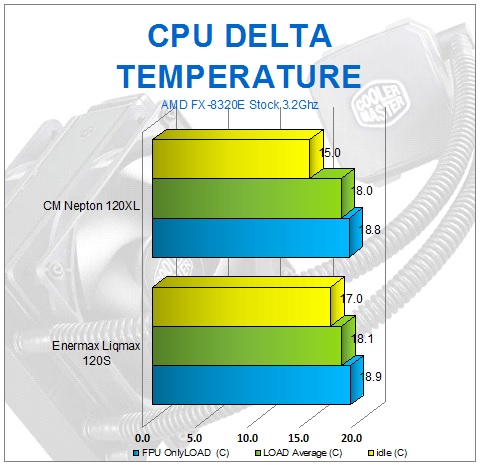
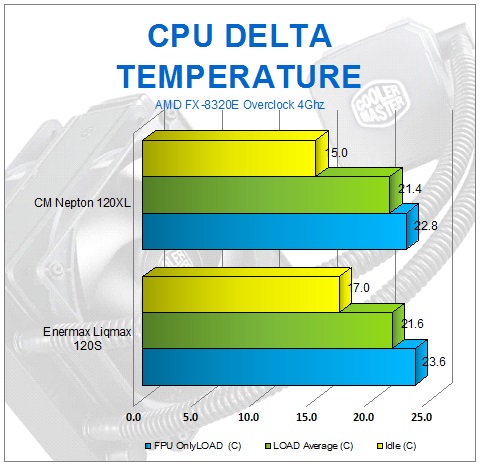
Ambient temperature monitored at case intake and temperature Delta was used.
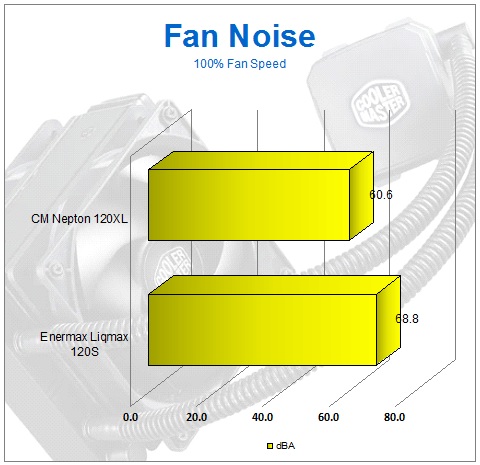
All case and heat sink fans were benchmarked with fan control settings disabled and running at 100% unless otherwise specified.
Temperatures are averaged (last minute) from individual core temperature results monitored by AIDA64 after 15 minutes.
FPU load average is used to simulate worst case scenario load levels similar to Intel Burn Test or OCCT, results marked “0″ means thermal limit was reached and the CPU was throttled and thus the results were discarded.
Stock settings have all power saving features enabled in the motherboard with Vcore set static to 1.264V and set to “Balanced” in the OS. Multiplier at 16 at stock speed of 3.2GHz.
Overclocked settings have Vcore voltage automatically set to 1.264V with adjusted multiplier set at 20 to gain overclock at 4.0GHz.
All tests were taken at least three times to get the final result.
TDJ 834 was used for noise level measurement in dBA, 20CM away from the center fan exhaust.
MSI 970 GAMING (MS-7693) BIOS(v22.2),Build Date (20141216)
Operating System
Windows 7 x64 Professional SP-1 with latest patches and updates
Benchmarks:
Performance Summary:
Nepton 120XL performed slightly better than Enermax Liqmax 120S. Temperatures I have gotten on stock and over clock CPU speeds were very low and stable. Fan noise was measured from the exhaust of the case and overall was relatively low considering the fans were running at 100% under all benchmarks. FPU benchmarks ran a little bit hotter but still with in the expected temperatures. From what I saw, Nepton 120XL performed very well in my test rig under stock and over clocked settings.
We use essential cookies to make our site work. We may also use non-essential cookies to improve user experience and analyze website traffic. By clicking “Accept,” you agree to our website's usage of Cookies.
Functional
Always active
The technical storage or access is strictly necessary for the legitimate purpose of enabling the use of a specific service explicitly requested by the subscriber or user, or for the sole purpose of carrying out the transmission of a communication over an electronic communications network.
Preferences
The technical storage or access is necessary for the legitimate purpose of storing preferences that are not requested by the subscriber or user.
Statistics
The technical storage or access that is used exclusively for statistical purposes.The technical storage or access that is used exclusively for anonymous statistical purposes. Without a subpoena, voluntary compliance on the part of your Internet Service Provider, or additional records from a third party, information stored or retrieved for this purpose alone cannot usually be used to identify you.
Marketing
The technical storage or access is required to create user profiles to send advertising, or to track the user on a website or across several websites for similar marketing purposes.